The Evolution of the Piper Cub
Few aircraft have had a greater impact on American general aviation than the Piper Cub. First introduced in the 1930s, the Cub evolved from a simple, affordable trainer into one of the most versatile and recognizable aircraft ever built, serving in military operations and recreational flying before becoming the foundation of modern backcountry aviation. Over the decades, successive generations brought improvements in horsepower, capability, construction, and performance while preserving the simplicity and character that made the original so successful. This blog traces the evolution of the Cub through six defining aircraft, highlighting the history, innovations, and lasting influence of an airplane that continues to shape aviation today.
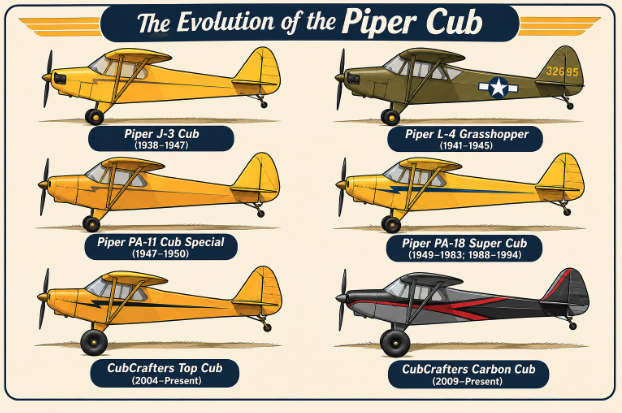
Piper J-3 Cub (1938–1947)
The J-3 Cub established the foundation for the entire Cub family, becoming one of the most recognizable and influential light aircraft in aviation history. Typically powered by a 65-horsepower Continental engine, it featured tandem seating, a fabric-covered steel-tube fuselage, fixed landing gear, and exceptionally forgiving low-speed handling. Designed as an affordable trainer and personal aircraft, the J-3 was defined by its lightweight construction, simplicity, and ability to operate from short grass strips, which established the characteristics that would define the Cub for generations.
Piper L-4 Grasshopper (1941–1945)
The L-4 Grasshopper was the military adaptation of the J-3 Cub, developed for the United States Army during World War II. Mechanically similar to its civilian counterpart, it featured expanded windows for improved visibility and was used extensively for reconnaissance, artillery spotting, liaison, and personnel transport. Its service during the war demonstrated the Cub’s remarkable ability to operate from unimproved airstrips and established its reputation as a capable utility aircraft.
Piper PA-11 Cub Special (1947–1950)
The PA-11 Cub Special was Piper’s postwar refinement of the original J-3, incorporating a number of improvements while retaining the aircraft’s familiar lightweight design. It featured an enclosed engine cowling, improved engine options, revised fuel tank placement, and a seating arrangement that allowed pilots to fly solo from the front seat. Although visually and structurally similar to the J-3, the PA-11 introduced several design elements that would carry directly into the Super Cub.
Piper PA-18 Super Cub (1949–1983; 1988–1994)
The PA-18 Super Cub represented a substantial evolution of the original Cub, introducing a strengthened airframe, improved structural capabilities, and significantly more horsepower. Available with engines ranging from 90 to 150 horsepower, it offered improved payload, climb performance, and versatility while retaining the familiar tandem-seat configuration and tailwheel design. Its combination of short-field performance, rugged construction, and adaptability made it one of the most influential bush planes ever produced.
CubCrafters Top Cub (2004–Present)
Introduced in 2004, the Top Cub brought the traditional Super Cub design into a modern, factory-produced aircraft with its own FAA type certificate. Built around the proven PA-18 platform, it incorporated a 180-horsepower engine, strengthened components, modern construction techniques, and improved backcountry capabilities. The Top Cub retained the classic Super Cub appearance and flying characteristics while delivering a more capable, refined, and standardized aircraft straight from the factory.
CubCrafters Carbon Cub (2009–Present)
The Carbon Cub marked a significant departure from the traditional Super Cub formula, introducing a modernized, lightweight design focused on maximizing power-to-weight ratio and short-field performance. Originally introduced as the Sport Cub and subsequently developed into the Carbon Cub SS, it combined lightweight construction, a 180-horsepower engine, modern materials, and updated systems to deliver exceptional backcountry performance. The platform has since expanded into numerous configurations, including the EX, FX, and UL models, continuing to push the limits of what a Cub-style aircraft can accomplish.
Generations after the first J-3 rolled off the production line, the Cub remains one of the most respected and influential aircraft designs in aviation history. Its evolution from a simple trainer into today’s highly capable backcountry machines is a testament to the versatility of the original design and the generations of pilots, builders, and manufacturers who continued to push it forward.
Whether you’re interested in the history, looking to own one, or considering selling your aircraft, feel free to reach out to learn more about the Cub market and the aircraft that continue to carry its legacy forward.
Blue Skies,
Clay Simmons
CubCrafters Specialist